Evidence file 01 · Updated July 28, 2026
Metatronics withdrawal proof
Two completed transaction records, dated July 25 and 26, 2026, examined without turning selected payments into a promise about the whole platform.
Editorial conclusion
The submissions support a completed 244 USDT receipt and a completed 36.01 USDC external transfer. Neither image visibly identifies Metatronics as the sender, so attribution and profit origin remain unconfirmed.
- Receipt
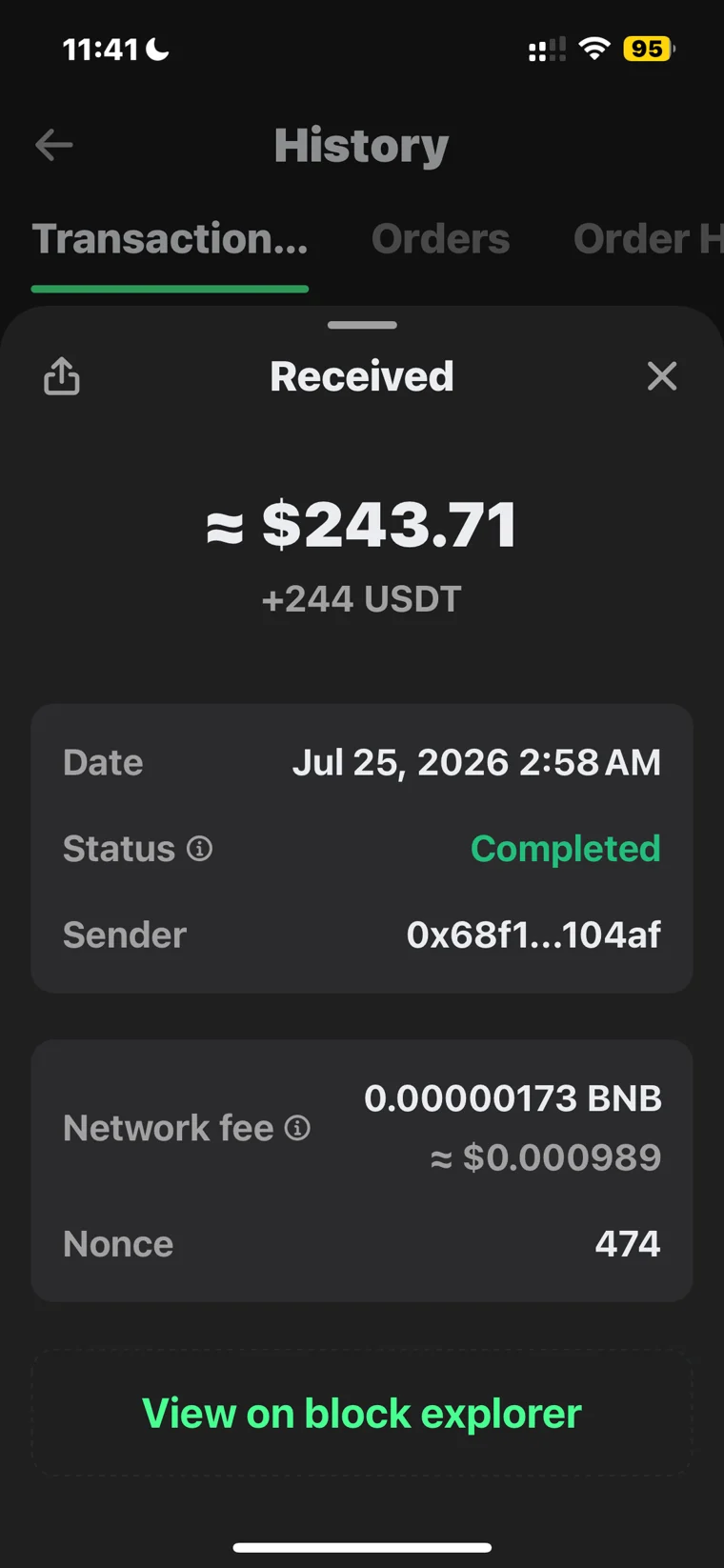
- 244 USDT received on July 25
- Transfer
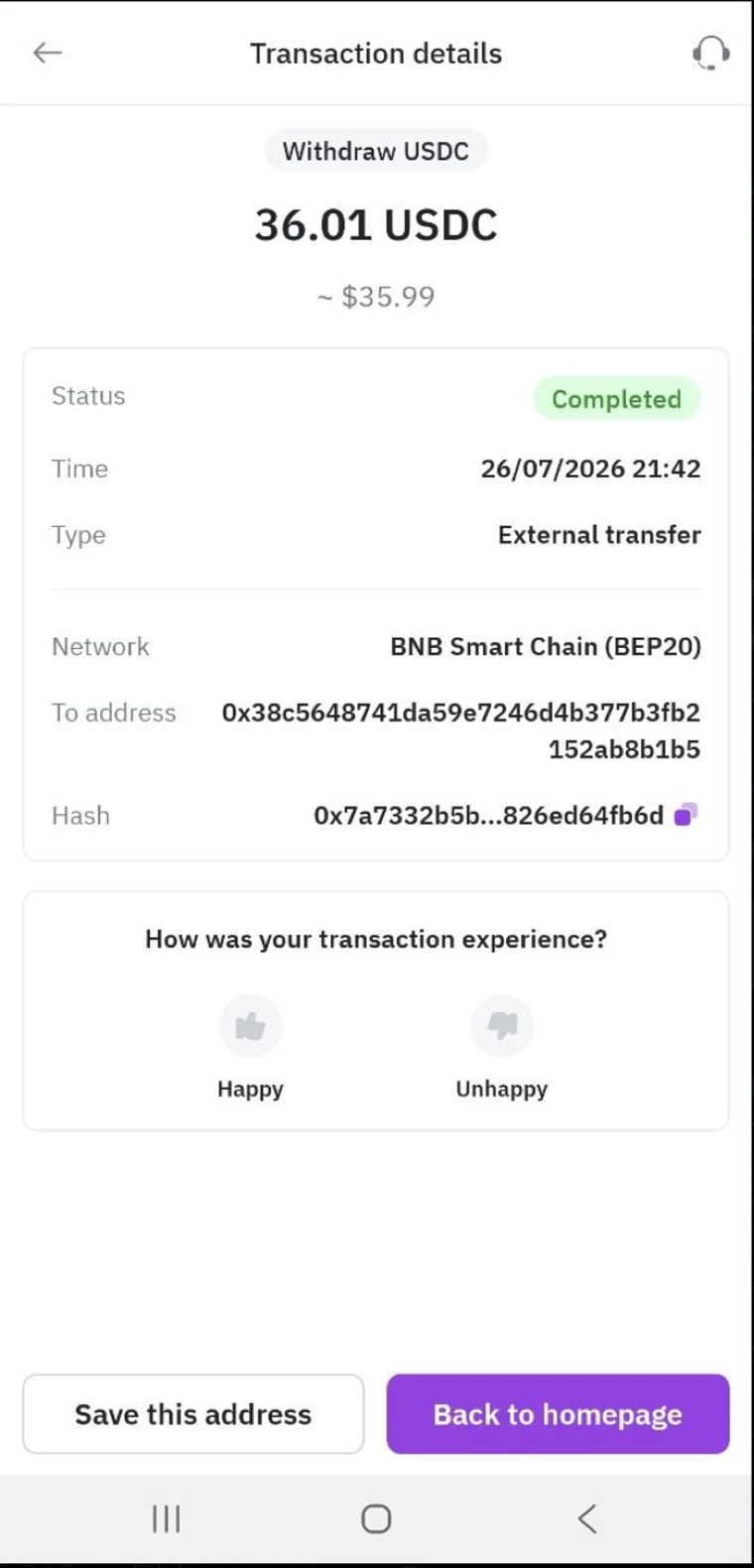
- 36.01 USDC completed on July 26
- Network
- BNB Smart Chain shown for the USDC transfer
- Limit
- No complete transaction hash or visible Metatronics sender label
Submitted evidence
Read each image narrowly.
These screenshots are reproduced from user submissions. They support only the details visible in each record; they are not an audit of the platform, proof of trading-profit origin, or a promise that every withdrawal will complete.
What is actually visible
The image shows a receiving-wallet transaction screen. The transaction is labelled “Received,” the amount is +244 USDT, the approximate fiat value displayed is $243.71, and the status is “Completed.” The date shown is July 25, 2026 at 2:58 AM. A shortened sender address beginning 0x68f1 and ending 104af is visible. The screen also displays a network-fee line of 0.00000173 BNB, approximately $0.000989 at the value used by the wallet interface. Those are the facts that can be read directly from the supplied image.
The second record shows “Withdraw USDC,” an amount of 36.01 USDC, a completed status, an external-transfer type, BNB Smart Chain (BEP20), the destination address and a shortened transaction hash. Its timestamp is July 26, 2026 at 21:42. The visible details make it a useful transaction record, but the screenshot does not show a Metatronics brand or sender label, and the shortened hash cannot be independently opened from the image alone.
A receiving-wallet record is stronger than an image of an internal Metatronics balance because it shows assets reaching a wallet interface. Internal income entries show only what a platform credits to an account. Even so, both submissions have important limits: neither provides a complete transaction hash paired with a matching Metatronics withdrawal request. This page therefore does not claim that an editor independently attributed either transfer to Metatronics or verified it on a block explorer.
What one completed receipt does not prove
A completed withdrawal is useful evidence of payment at one point in time. It is not proof of solvency, audited trading, future liquidity, or the origin of returns. A platform can process a real withdrawal without proving how it generated the money. The receipt cannot establish whether the 244 USDT came from external trading profits, a treasury wallet, operating funds, another participant’s deposits, or a different source. Answering that question would require a much broader reconciliation of deposits, exchange accounts, trading records, fees, losses, and outgoing payments.
The official Metatronics security page describes a custodial pool divided between hot and cold storage. It says the hot portion supports execution and payouts while a reserve is held separately. That is the operator’s description of its architecture, not an independent audit. If users transfer funds to platform-controlled wallets and later request a payout, they depend on the operator’s custody controls and ability to process requests. A successful test withdrawal reduces uncertainty about the mechanics for that user on that date, but it does not remove counterparty risk.
Timing must also be stated carefully. The supplied image shows the receipt time, not the time the withdrawal request was submitted. Without both timestamps, the processing duration cannot be calculated. It would be inaccurate to describe this as an instant, thirty-second, or same-hour withdrawal based only on the evidence supplied. The official site publishes withdrawal claims and statistics, but platform-published figures remain company statements unless an outside party can reproduce them from complete records.
How a stronger withdrawal test should be documented
A useful evidence package begins before the withdrawal button is pressed. Record the balance, requested amount, selected network, destination address, quoted fee, and submission time. After submission, capture the platform’s pending and completed states. Then record the receiving wallet’s timestamp and copy the full transaction hash. Open that hash in the correct public block explorer and confirm the token contract, transfer amount, sender, recipient, block status, and number of confirmations.
The strongest public version does not need to expose sensitive information. Wallet addresses can be shortened consistently while leaving enough characters to match the platform record to the explorer record. Account numbers, private balances, QR codes, recovery phrases, email addresses, phone numbers, and authentication details should be hidden. A transaction hash is public blockchain data, but publishing it links the transaction to the person sharing it, so the owner should understand that privacy trade-off before posting it.
- Capture the request amount, network, destination, fee and submission time.
- Capture the platform’s completed-withdrawal record.
- Capture the receiving wallet and retain the complete transaction hash.
- Verify token, chain, sender, recipient, amount and status on the block explorer.
- Keep a written record of total processing time and any support contact.
A practical test-withdrawal protocol
Anyone considering a custodial crypto platform should test the exit path with an amount small enough to lose. First confirm that the sending and receiving networks match. USDT exists on multiple networks, and selecting the wrong one can cause loss or require difficult recovery. Check the minimum withdrawal and fee inside the live app because terms can change. Use a receiving wallet or exchange account that supports the exact network shown in the withdrawal form.
After submitting, avoid sending repeated requests or changing addresses while the first transaction is pending. Save screenshots and note local time and time zone. When the transfer arrives, verify the net amount against the quoted fee. If the explorer shows success but the wallet does not display the token, confirm that the wallet supports the token contract before assuming the payment failed. If the platform shows completion but no matching on-chain transaction can be found, ask for the transaction hash through official support and do not increase the deposited balance until the discrepancy is resolved.
Repeatability matters more than one dramatic screenshot. A transparent withdrawal log would include multiple tests over time, both ordinary and busy market periods, and would report failed or delayed attempts as clearly as successful ones. It should never imply that previous payments guarantee future payments. Liquidity, platform rules, network congestion, compliance checks, account restrictions, security incidents, and operator decisions can all change the outcome of a later request.
Editorial assessment
This page classifies the submissions as supporting evidence for two completed transaction records, not complete Metatronics withdrawal proof. The visible amounts, dates, statuses, network and destination details are meaningful. The absence of complete hashes paired with matching Metatronics withdrawal requests prevents independent attribution. If those records are supplied later, this page can be updated with transaction-level comparisons and precise processing times.
The correct takeaway is neither “the screenshots prove everything” nor “screenshots mean nothing.” They prove what they show: a wallet interface recorded 244 USDT received, and another interface recorded a completed 36.01 USDC external transfer. They do not prove that Metatronics sent either transfer, that trading generated the funds, that every user can withdraw, or that the platform will remain able to pay. Readers should combine transaction evidence with corporate due diligence, custody analysis, independent performance verification, current terms, and a personal risk limit before making any decision.
Source register
What this page relies on.
Official security architecture ↗
Operator description of its custodial pool, hot and cold storage, access roles and internal controls.
Official statistics page ↗
Platform-published statistics and access to the operator’s reporting environment; not an external audit.
Withdrawal guide ↗
Our practical walkthrough covering networks, fees, timing and troubleshooting.
Risk disclosure ↗
Material trading, custody, technical and counterparty risks to consider before depositing.
Metatronicsbot.com is an independent affiliate publisher, not the platform operator. Company statements are identified as claims rather than treated as independent proof. Crypto trading can result in partial or complete loss.